Why Your Guests Are Leaving Without Telling You What Went Wrong
The most expensive feedback a boutique hotel receives is the feedback it never gets.
The scenario plays out hundreds of times a year at independent properties across the country. A guest has a mediocre experience. Nothing terrible. The room was fine. Check-in was a little slow. The shower pressure was weaker than expected. Nobody asked how their stay was going. They check out, leave a polite smile at the front desk, and drive away.
Two weeks later, they leave a 3-star review on TripAdvisor. The owner reads it and wonders what happened. From the inside, the stay looked normal. The guest did not complain. Nothing seemed wrong. But from the guest's perspective, the stay was forgettable. And forgettable, in hospitality, is a failing grade.
This is the silent revenue leak that most independent hotels do not measure. It is more common than the dramatic one-star complaints that get management attention. And it costs significantly more over time because it compounds across hundreds of stays that could have been saved with a single well-timed message.
Why Guests Stay Silent
Most hotel guests, particularly those staying at boutique and luxury properties, will not walk to the front desk to report a minor issue. They are on vacation. They do not want confrontation. They do not want to feel like they are being difficult. They absorb the friction, tell themselves it is not worth mentioning, and process their disappointment later.
The problem is not that these guests are unreasonable. The problem is that the hotel gave them no easy, low-friction way to surface the issue during the stay. Walking to the front desk feels like a complaint. Responding to a friendly text message feels like a conversation.
Hotels that implement mid-stay communication, whether automated or personal, consistently find that guests will mention issues they would never have raised in person. The lukewarm shower. The room above that was noisy until midnight. The parking situation that was more confusing than expected. These are exactly the kinds of problems that are fixable in real time if the hotel knows about them.
What Silence Actually Costs
A 25-room hotel running 65% occupancy hosts roughly 5,900 stays per year. If even 5% of those guests leave with an unresolved minor issue they never mentioned, that is 295 stays per year where the hotel missed an opportunity to recover the experience.
Some of those 295 guests will leave a lower review score than they would have if the issue had been addressed. Research from Cornell Hospitality suggests that a 1% increase in a hotel's online reputation score can drive up to a 1.42% increase in revenue per available room. A few dozen preventable three-star reviews per year can measurably erode pricing power.
Others will simply not return. They will not leave a bad review. They will not complain to anyone. They will just book somewhere else next time. In an industry where repeat guests are significantly more profitable than new ones, this silent attrition is one of the most expensive problems a hotel can have.
And some will tell friends, family, or colleagues about their mediocre experience. Word of mouth is now the second most influential factor in hotel selection, with personal recommendations doubling to 14% as a research starting point according to SiteMinder's 2026 data. A forgettable stay does not just lose one guest. It removes one potential advocate from your referral pipeline.
The Three-Touchpoint Solution
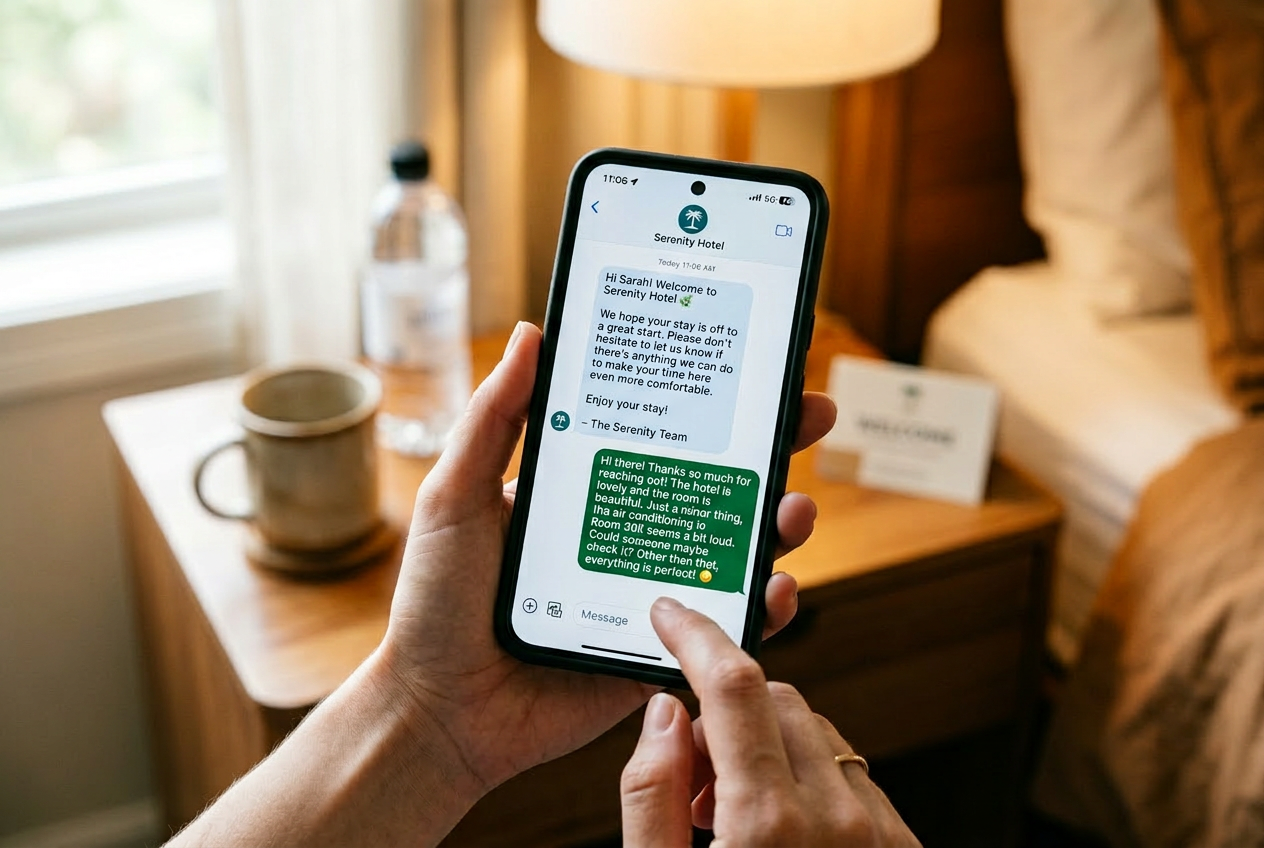
The fix is not complicated, and it does not require additional staff. It requires three automated messages that run for every guest, every stay.
Touchpoint one: pre-arrival message, 48 hours before check-in. This message does three things. It sets expectations by providing check-in details, parking instructions, and a brief note about what to expect on arrival. It captures preferences by asking a simple question about special occasions, dietary needs, or any requests. And it offers an upsell, typically late checkout, a room upgrade, or a breakfast package, at a price point the guest can accept with a single reply.
The pre-arrival message is the most commercially valuable of the three touchpoints. It generates ancillary revenue through upsell offers, it surfaces guest information the front desk can use to personalize the arrival, and it makes the guest feel expected rather than processed.
Touchpoint two: mid-stay check-in, morning after the first night. This is the message that prevents the silent departure. A simple text: 'Good morning. How is everything so far? Anything we can help with?' gives the guest permission to surface an issue in a low-friction format. The guest who would never walk to the front desk will almost always reply to a text.
Properties that implement mid-stay check-ins report two measurable outcomes. First, on-property issue resolution increases because problems get surfaced while they can still be fixed. A lukewarm shower reported at 9am gets resolved by noon. The same issue reported in a review two weeks later gets a templated apology that helps nobody. Second, post-stay review scores improve because the guest feels heard, even when the issue was minor and easily resolved.
Touchpoint three: post-stay follow-up, 24 to 48 hours after checkout. This message thanks the guest, asks for a review, and offers a reason to return, whether that is a direct booking link, a seasonal package, or a simple personal note from the owner. The post-stay message is the beginning of the repeat guest relationship that OTAs cannot replicate.
Why This Works Better Than Staff Availability
Most boutique hotel owners will say that their staff is friendly and available, and they are right. The team genuinely cares about guests. The problem is that availability is not the same as proactive outreach.
A guest with a minor issue will not interrupt a busy front desk to mention it. But that same guest will respond to a well-timed message that meets them where they already are, on their phone.
The difference between reactive hospitality and proactive hospitality is not attitude. It is infrastructure. The hotels with the best guest satisfaction scores are not the ones with the friendliest staff, although friendliness matters. They are the ones with communication systems that ensure every guest is reached at the moments when it matters most.
Three touchpoints. Pre-arrival, mid-stay, post-stay. Automated, consistent, running every day without adding a single task to the front desk workload. The total time to set up this sequence properly is about 90 minutes. Once running, it works for every guest, every stay, indefinitely.
Measuring the Impact
Properties that implement all three touchpoints typically see measurable changes within 60 to 90 days. Review scores increase as mid-stay check-ins prevent the silent departure pattern. Ancillary revenue increases as pre-arrival upsell offers convert at rates between 8 and 15%. And repeat booking rates increase as post-stay follow-ups keep the hotel in the guest's mind when they plan their next trip.
The guest communication gap is one of the most common and most costly operational problems at independent boutique hotels. It is also one of the simplest to fix. The technology exists, the implementation is straightforward, and the ROI is measurable within a single quarter.
The guests are not silent because they have nothing to say. They are silent because nobody asked.
Is the Communication Gap Costing Your Property?
BNHG helps independent boutique hotels build guest communication systems that close the gap between booking and checkout. If your property sends a confirmation email and nothing else until the guest arrives, a 15-minute discovery call will show you what that gap is costing and what fixing it looks like.
Book a free discovery call at http://www.benicehospitality.com