Spring travel season is a stress test. Not for your rooms or your location. For your systems.
Every year, the pattern repeats. Occupancy climbs from the mid-50s into the high 70s or low 80s. The phone rings more often. OTA notifications stack up. Guest inquiries multiply. And the operational cracks that were manageable at low volume become visible to guests, staff, and eventually to review scores.
For branded hotel chains, spring is just another gear shift. Their dynamic pricing adjusts automatically. Their CRM campaigns trigger without anyone pressing a button. Their loyalty emails go out on schedule because the system was built to handle the volume.
For independent boutique hotels with 10 to 50 rooms, spring is the season that exposes every gap in the operation. Not because the hotel is poorly run. Because the hotel was never given the infrastructure to run at scale.
Hotel prices are up 3% domestically and 7% internationally heading into spring 2026, according to data from Priceline and CoStar Group. Occupancy projections for U.S. hotels sit in the 62 to 64% range this year with ADR growth of 1 to 3%. That is not a boom. It is a moderate growth market that rewards the properties with the best commercial systems, not just the best locations.
Here are the five operational gaps that spring demand consistently exposes at independent properties, and what each one costs when it is left unaddressed.
Gap One: Communication Breaks Down Under Volume
At 55% occupancy, the front desk can handle guest inquiries personally. The owner or GM might even respond to pre-arrival emails themselves. At 80%, messages get missed. A guest emails asking about early check-in and nobody responds until after they have already arrived. A couple celebrating an anniversary mentions it in a booking note that never reaches the person setting up the room.
Each missed message is a small erosion of trust. Individually, none of them feels catastrophic. But they accumulate in reviews. After analyzing review patterns across dozens of independent properties, we consistently find that communication gaps before arrival are one of the most frequently mentioned complaints in three-star reviews at otherwise well-reviewed hotels.
The fix is not more staff. It is a pre-arrival communication sequence that runs automatically. A message 48 hours before arrival with check-in details, parking instructions, and a simple question asking about preferences or special occasions. Properties that implement this single automation see two measurable outcomes: fewer front desk friction points on arrival day and higher guest satisfaction scores within 60 to 90 days.
Gap Two: Pricing Becomes Reactive When Rooms Start Selling
When the calendar fills up, most independent hotel owners feel relieved rather than strategic. Rooms are selling. The anxiety of empty nights fades. And in that relief, they stop adjusting rates.
But the rooms selling fastest are almost always the ones priced too low. Without dynamic pricing discipline, high-demand weekends and local event dates get sold at mid-demand rates. A property that should be charging $260 for a Saturday in April sells it at $220 because that was the rate set in January and nobody revisited it.
The math is straightforward. For a 25-room boutique hotel, underpricing peak nights by $30 across a 60-day spring and summer season costs roughly $45,000 in missed revenue. That is not theoretical. That is the difference between a property that prices proactively and one that prices by checking what the hotel across the street is charging on Expedia.
The branded chains have revenue management systems that adjust rates based on demand signals, competitor pricing, booking pace, and length of stay patterns. Independent hotels do not need enterprise-level software to capture some of this value. They need a pricing calendar reviewed weekly, rate fences for high-demand dates set in advance, and the discipline to raise rates when occupancy crosses 70% for a given date.
Gap Three: Upsell Opportunities Disappear When the Desk Gets Busy
A busy front desk does not offer late checkout, breakfast packages, or experience add-ons because the team is focused on getting guests checked in and checked out without a line forming. The revenue that ancillary offers generate at well-systemized properties simply does not get captured during peak periods at properties without automation.
Industry data shows that the average ancillary spend per stay at hotels with active upsell systems ranges from $35 to $60. Properties with highly structured workflows, including pre-arrival offers, in-stay promotions, and curated local experiences, report per-stay ancillary revenue exceeding $100.
For a 25-room hotel with 65% occupancy, that is approximately 5,900 stays per year. At $40 per stay in ancillary revenue, the property generates $236,000 in incremental annual income. At $100 per stay, it approaches $590,000. The difference between those two numbers is not a bigger spa or a fancier restaurant. It is a communication system that presents the right offer at the right time.
A guest offered late checkout at 7am on checkout morning will almost always say no. The same guest offered late checkout at $35 in a text message 48 hours before arrival will say yes far more often than most owners expect.
Gap Four: Staff Inconsistency Becomes Visible to Every Guest
At low occupancy, your best employee can cover for your weakest one. The experienced front desk agent handles the tricky situations. The newer hire gets the quieter shifts. Nobody notices the gap because there is enough slack in the system.
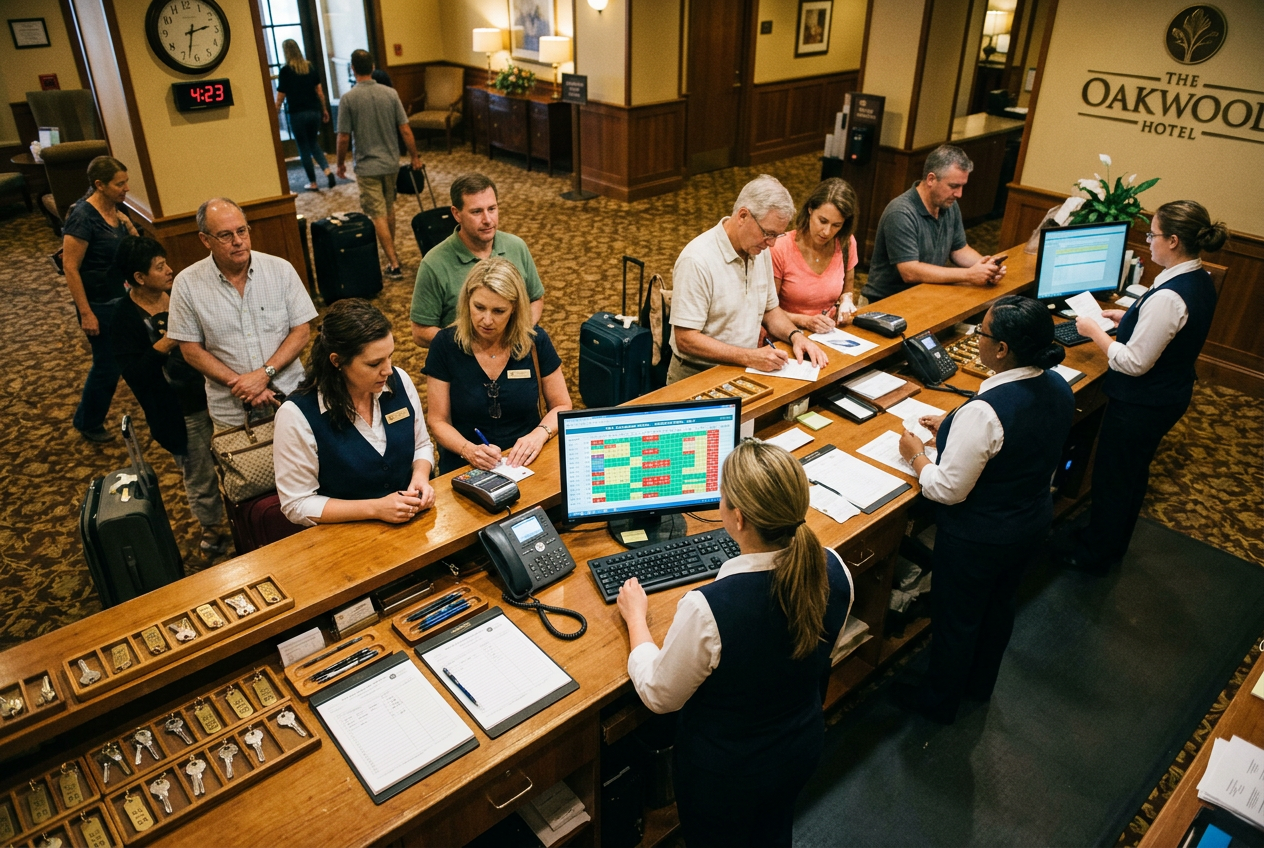
At high occupancy, every team member is visible to guests on every shift. Tuesday's five-star check-in experience becomes Thursday's three-star check-in because a different person was at the desk and they did not follow the same steps. One shift offers a warm welcome with a brief property tour. The next shift hands over a key card and points toward the elevator.
The hospitality industry is projected to face an 18% staffing shortfall below required levels in 2026, according to the WTTC. Housekeeping remains the hardest role to fill, with 38% of hotels reporting shortages. For a boutique hotel with a team of eight or ten people, losing even one trained staff member during peak season can visibly change the guest experience.
The solution is not finding better people. It is building standard operating procedures that define the experience regardless of who is delivering it. A check-in SOP that takes every guest through the same five steps. A housekeeping standard that specifies the same room setup every time. A service recovery process that gives any team member the authority and the script to resolve a complaint on the spot.
Properties with documented SOPs do not just deliver more consistent experiences. They onboard new hires faster, which matters enormously in a labor market where the average time to train a front desk employee should be under two days.
Gap Five: Review Quality Dips During Your Best Revenue Months
This is the most counterintuitive pattern in boutique hotels. The months with the highest occupancy often produce the weakest reviews. Not because the hotel is doing anything differently. Because the operational strain of running at 80% instead of 55% shows up in the guest experience in ways the team does not see from the inside.
Slightly slower response times. A missed housekeeping request that would have been caught at lower volume. A front desk interaction that felt rushed because three other guests were waiting. None of these are service failures. They are capacity failures. And they show up in reviews as a slow erosion of the scores that drive future pricing power.
Research from Cornell Hospitality suggests that a 1% increase in a hotel's online reputation score can drive up to a 1.42% increase in revenue per available room. The reverse is also true. When review scores dip during peak season, the hotel loses pricing leverage for the months that follow.
The properties that avoid this pattern have one thing in common. They built systems that scale with demand instead of breaking under it. Automated communication that runs whether the hotel is at 55% or 85%. Pricing discipline that does not require the owner to manually adjust rates every week. Upsell workflows that do not depend on the front desk remembering to offer them. SOPs that deliver the same experience on the busiest Saturday as on the quietest Tuesday.
The Common Thread
None of these five gaps require more staff to close. None of them require a massive technology investment. What they require is a shift from reactive operations to proactive systems. Communication automation, pricing calendars, upsell sequences, and documented standards that run consistently regardless of occupancy levels.
Spring 2026 is already arriving. The properties that address these gaps now, before demand peaks, will capture significantly more revenue from the same number of guests. The properties that wait will repeat the same cycle they repeated last year.
The infrastructure gap between independent boutique hotels and branded chains is real. But it is also closable. And the ROI on closing it is measurable within a single season.
Is This Happening at Your Property?
BNHG works with independent boutique hotels to diagnose exactly where spring demand exposes operational gaps and build the systems to close them. If any of the patterns in this article sound familiar, a 15-minute discovery call is the fastest way to find out what fixing them would look like for your specific property.
Book a free discovery call at https://www.benicehospitality.com