What OTA Dependency Actually Costs a 30-Room Boutique Hotel
The Math Nobody Shows You
Most independent hotel owners know they pay commissions to online travel agencies. They know the percentage. They signed the contract. The number sits somewhere in the back of their mind as a cost of doing business.
What most owners have never done is calculate the total cost of OTA dependency across a full year. Not just the commission line item. The full picture, including the revenue they never captured, the guest relationships they never built, and the pricing power they quietly surrendered.
Here is that calculation for a typical 30-room upscale boutique hotel in the Southeast United States. The numbers are based on industry benchmarks and the patterns we observe across independent properties in this segment.
The Baseline Numbers
The property: 30 rooms. Average daily rate of $225. Annual occupancy of 68%. That produces roughly 7,446 room nights sold per year, generating about $1.675 million in annual room revenue.
The booking mix: 60% of those bookings come through OTAs. That is consistent with industry data from Phocuswright, which found that OTAs captured 61% of bookings for independent properties in 2024. For branded hotel chains, the OTA share is around 35%. That 25-percentage-point gap is the infrastructure gap that defines independent hotel economics.
The blended commission rate: 18%. This accounts for the standard 15% base commission on most platforms, plus the incremental costs of promotional placements, preferred partner programs, visibility boosters, and the occasional heavily discounted rate required to maintain competitive positioning. Most owners think their commission rate is 15%. Their actual blended rate, calculated from real invoices, is almost always higher.
The Visible Cost: $181,000 in Annual Commissions
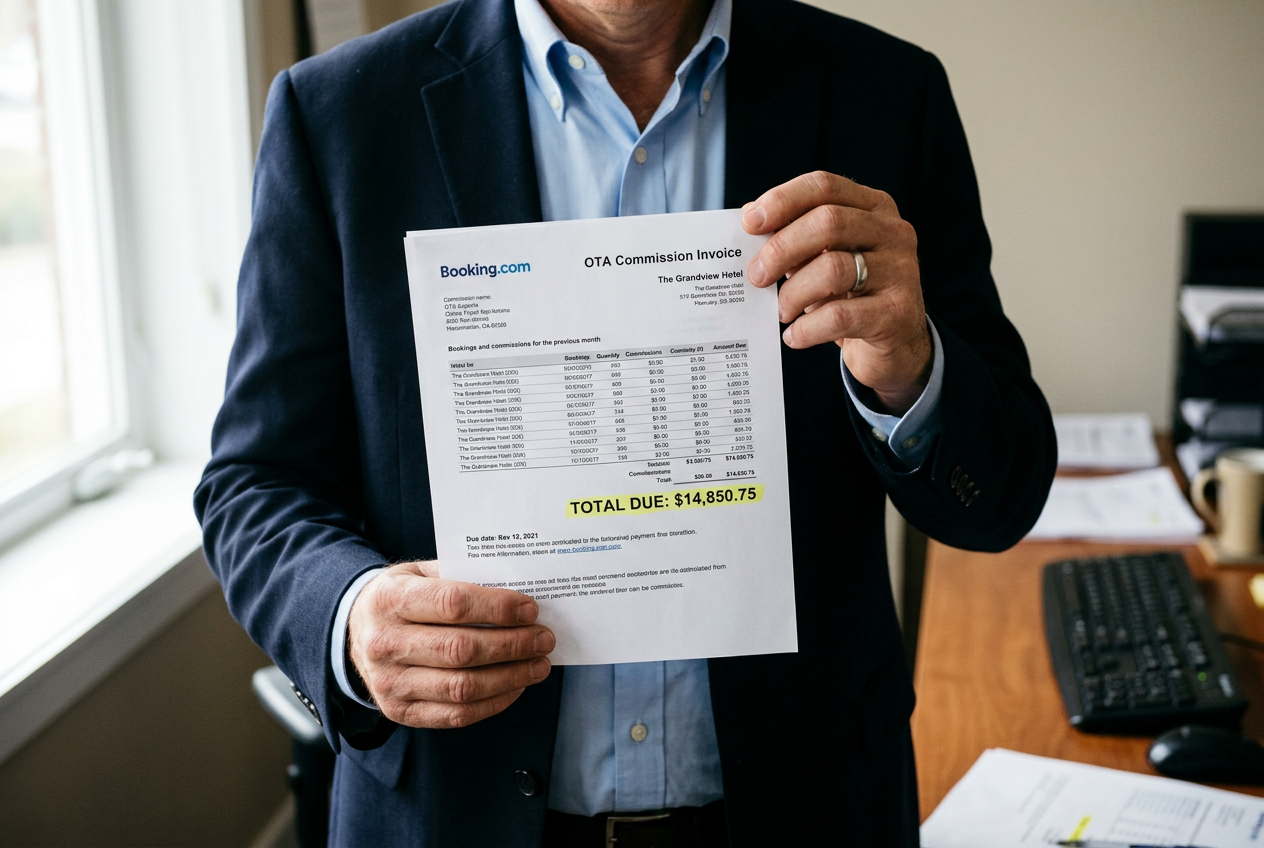
At 60% OTA share, approximately 4,468 room nights per year are booked through OTA channels. At a $225 ADR and an 18% blended commission rate, the hotel pays approximately $181,000 per year in OTA commissions.
That number alone is significant. It represents roughly 10.8% of total room revenue going directly to intermediaries. But it is only the cost the hotel can see on an invoice.
Hidden Cost One: Rate Erosion
OTAs frequently display rates below the hotel's own website. This happens through opaque pricing, bundled packages, loyalty program discounts, and the increasingly common practice of OTAs using part of their commission to fund guest-facing discounts.
When a potential guest visits the hotel's website, sees a rate of $225, then checks Booking.com and sees $209 for the same room on the same night, they book on the OTA. The hotel pays the commission AND loses rate integrity. Over time, this trains guests to always check the OTA, even for properties they already know and like.
The revenue impact of rate undercutting is difficult to quantify precisely because it varies by market and platform. But even a conservative estimate of 3 to 5% rate erosion on OTA-sourced bookings adds $30,000 to $50,000 in annual revenue loss for this property profile.
Hidden Cost Two: Data Loss and Missed Ancillary Revenue
OTA bookings often mask guest email addresses and restrict the hotel's ability to communicate directly before arrival. This means no pre-arrival upsell offer, no preference collection, no personalization opportunity, and no post-stay email that could drive a direct rebooking.
Properties with active guest communication systems report ancillary revenue of $35 to $60 per stay through upsells like late checkout, breakfast packages, room upgrades, and local experience partnerships. For OTA guests who arrive without any pre-arrival communication, that ancillary capture drops close to zero.
At 4,468 OTA-sourced stays per year with $40 per stay in missed ancillary revenue, the data loss costs this property approximately $178,000 annually in revenue it could have captured if it owned the guest relationship.
Even adjusting for the fact that not every OTA guest would convert on every upsell, the gap between properties that communicate proactively with guests and those that do not is measured in six figures annually at this property size.
Hidden Cost Three: Higher Cancellation Rates
OTA bookings carry significantly higher cancellation rates than direct bookings. Industry data consistently puts direct booking cancellations around 12%. OTA cancellation rates vary by platform and policy but run considerably higher, often 30% or more on flexible rate plans.
Each cancellation creates empty inventory that the hotel must resell, often at a lower rate or through the same OTA channel that generated the cancellation. The compounding effect, cancellation followed by a discounted resale followed by another commission payment, erodes revenue in ways that never show up on a single line item.
For a 30-room property, the incremental revenue loss from OTA cancellation friction conservatively adds $15,000 to $25,000 annually in resale discounts, last-minute rate drops, and double commission costs.
The Total Cost: Over $220,000 Per Year
When you add commissions ($181,000), rate erosion ($30,000 to $50,000), missed ancillary revenue ($178,000 in opportunity cost), and cancellation friction ($15,000 to $25,000), the total annual cost of OTA dependency for this 30-room property conservatively exceeds $220,000 in direct costs and far more when you include the ancillary opportunity cost.
To put that in perspective, $220,000 is the annual salary of a full-time revenue manager, a complete website redesign, and a year of CRM software combined. The money being spent on OTA dependency could fund the infrastructure that reduces it.
What Rebalancing Looks Like
The goal is not to eliminate OTAs. They serve a real purpose in visibility and demand generation. For the first time in 2026, according to SiteMinder, 26% of travelers are starting their hotel search on Booking.com, overtaking Google as the primary research starting point. OTAs are now discovery channels, not just booking channels.
The goal is to rebalance the mix. Reducing OTA share from 60% to 45% would save this property over $55,000 per year in commissions alone, before counting the ancillary revenue gains from owning more guest relationships.
The properties that have achieved this rebalancing share three traits. First, their website booking experience matches or exceeds the OTA experience in speed, transparency, and mobile usability. Second, they display a best-rate guarantee prominently and give the guest at least one tangible reason to book direct, whether that is a welcome amenity, flexible cancellation, or a room upgrade. Third, they capture email addresses from website visitors who do not book immediately, and they run a simple email sequence that brings those visitors back to complete the booking.
None of these require a large budget. They require a deliberate decision to compete for the direct booking instead of conceding it.
How to Start This Week
Pull your OTA commission invoices from last quarter. Calculate the actual dollar amount across all platforms. Then calculate your blended commission rate by dividing total commissions by total OTA revenue. That real number, not the percentage in your contract, is what OTA dependency actually costs your property.
Once you have that number, the conversation changes. It is no longer about whether to invest in direct booking infrastructure. It is about how much of that OTA cost you can redirect into systems that capture the same demand at a fraction of the commission.
The math is not complicated. But most owners have never done it. Today is a good day to start.
Ready to Run These Numbers for Your Property?
BNHG builds custom revenue snapshots for independent boutique hotels that show exactly where OTA dependency is costing your specific property money and where the highest-ROI fixes are. A 15-minute discovery call is enough to determine whether the math justifies the conversation.
Book a free discovery call at https://www.benicehospitality.com