The Technology Audit Every Boutique Hotel Should Run Before Spending Another Dollar
Most independent hotels accumulate technology the same way they accumulate everything else. One problem at a time, one subscription at a time, with no master plan connecting any of it.
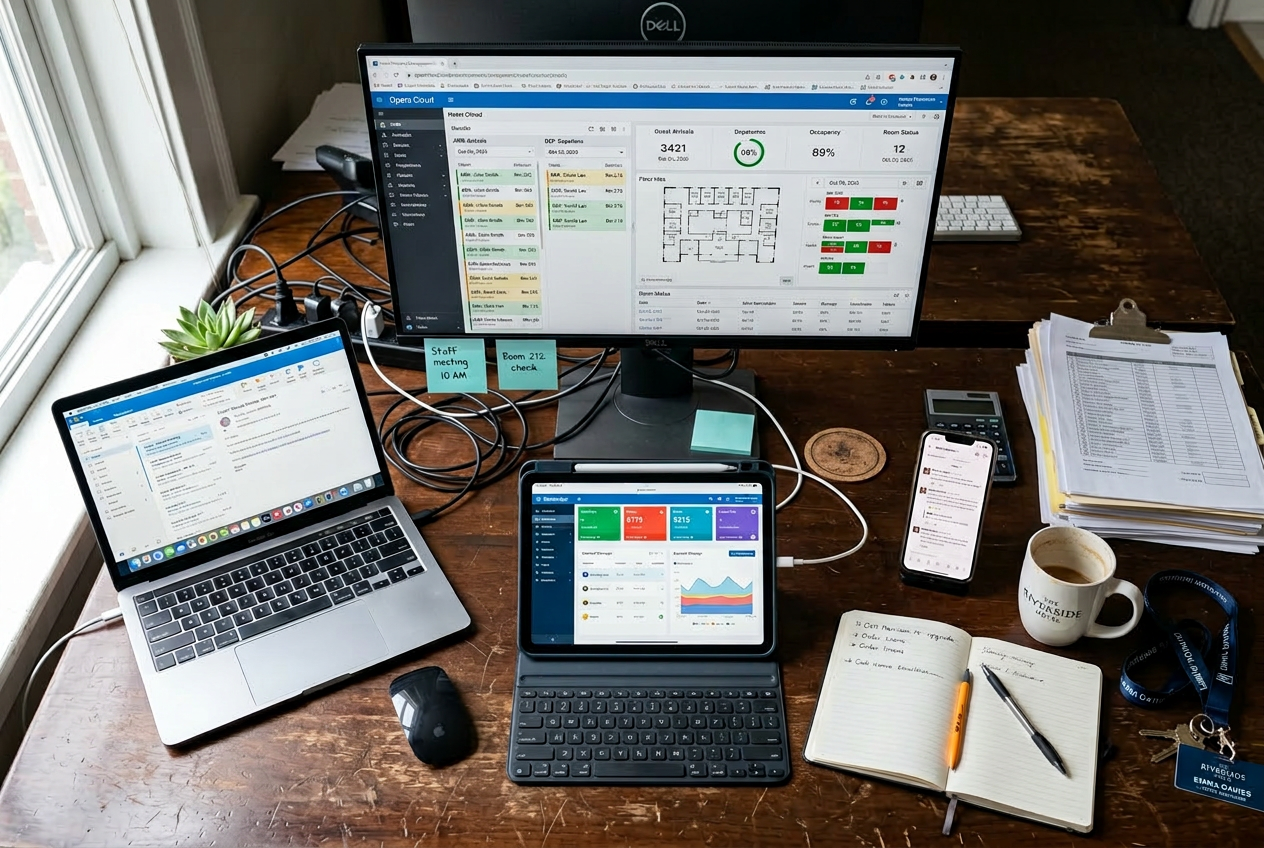
The PMS came first. It was probably chosen when the property opened or changed hands, selected based on a recommendation from another hotelier or a vendor who showed up at the right moment. Then a channel manager arrived to handle OTA distribution because the PMS default was not good enough. Then a separate booking engine because the built-in one felt clunky. Then a review management tool. Then a guest messaging platform. Then maybe an email marketing service that someone set up during a slow week and nobody has touched since.
The result, at most independent properties with 10 to 50 rooms, is a stack of four to six software tools that do not share data, require duplicate manual entry, and create gaps in the guest journey that nobody notices until a bad review surfaces or a double booking ruins a Saturday night.
According to data from the hotel technology sector, 36% of hotel owners say technology setup was the hardest part of opening their property. And for properties that have been operating for years, the problem is not setup. It is accumulation. Tools that made sense individually create chaos collectively.
Before buying another tool, upgrading an existing one, or listening to another vendor pitch, every boutique hotel should run a structured technology audit. It takes about two hours. The insights it produces can save thousands per year in redundant subscriptions and significantly more in recovered revenue from better-integrated operations.
Step One: List Everything and Tally the Real Cost
Open a spreadsheet or grab a piece of paper. Write down every software tool the property pays for monthly. Include the PMS, channel manager, booking engine, CRM, email marketing platform, review management tool, guest messaging system, revenue management software, accounting software, and anything else with a recurring subscription.
Next to each tool, write the actual monthly cost. Not the advertised price from the vendor's website. The real number from your credit card statement, including add-on modules, integration fees, per-room charges, and support costs. For most 20 to 40 room properties, the total lands between $800 and $2,500 per month. Some properties are paying closer to $3,000 when every hidden fee is accounted for.
This step alone is often eye-opening. Many owners have never added up their total monthly software spend across all tools. The number is almost always higher than they expect because each subscription was evaluated in isolation, never as part of a total cost.
Step Two: Test Whether Each Tool Shares Data
For each tool on your list, answer one question: does this tool automatically share data with at least one other tool in the stack?
If your PMS sends reservation data to your channel manager without anyone copying and pasting, that integration works. If your booking engine creates a reservation that appears in your PMS automatically, that integration works. If your guest messaging platform can pull a guest's name, arrival date, and room type from the PMS without someone manually entering it, that integration works.
If the answer is no for any tool, that tool is operating in a silo. Siloed tools create three specific problems. First, they require manual data entry that wastes staff time and introduces errors. Second, they create data gaps that lead to inconsistent guest experiences, like a guest who mentioned their anniversary in an email but the information never reached the front desk. Third, they make it impossible to build a unified view of the guest across their entire journey.
In 2026, the best PMS platforms connect to chatbots, CRMs, revenue tools, and guest messaging in a unified data layer. Properties with fully integrated tech stacks report reducing administrative time by 30 to 50% and dramatically improving data accuracy. That benchmark should be the target.
Step Three: Map the Guest Journey to Your Tools
Draw the guest journey from first website visit to post-stay follow-up. At each stage, identify which tool handles that touchpoint.
Website visit and browsing: which tool manages this? Booking and confirmation: which tool sends the confirmation and captures guest data? Pre-arrival communication: which tool sends messages between booking and check-in? Check-in: which tool manages the process? During stay: which tool handles guest communication and issue reporting? Checkout: which tool processes departure? Post-stay: which tool sends a review request and a reason to return?
If there is a stage where no tool is responsible, that is a gap. The most common gap at independent properties is between booking confirmation and check-in. Most hotels send a confirmation receipt and nothing else until the guest walks through the door. That gap is where expectations go unset, upsells go unsold, and personalization opportunities disappear.
If there is a stage where two tools overlap and both claim to handle the same touchpoint, that is waste. Overlapping tools mean you are paying two subscriptions for the same function, often with conflicting data.
Step Four: Score Each Tool on Three Criteria
For every tool on your list, ask three questions. First, is this tool producing measurable revenue? A booking engine that converts visitors into direct bookings produces revenue. A CRM that nobody uses does not. Second, is this tool saving measurable staff hours? A channel manager that syncs availability automatically saves hours every week. A review tool that still requires manual copy-pasting saves nothing. Third, is this tool improving measurable guest satisfaction? A guest messaging system that enables mid-stay check-ins and surfaces problems before they become reviews improves satisfaction. An email platform sending generic newsletters to an unsegmented list does not.
If a tool cannot answer yes to at least one of these three questions, it needs to be replaced, integrated, or eliminated. That is not a technology opinion. It is a business decision.
Step Five: Prioritize What to Fix First
Most properties that complete this audit discover two or three tools that need attention. The question is where to start.
Start with the tool that touches the most guest interactions. For most boutique hotels, that is the guest communication layer. If your property has no automated pre-arrival messaging, no mid-stay check-in, and no post-stay follow-up, that gap affects every single guest. Closing it produces the fastest measurable impact on review scores, ancillary revenue, and guest satisfaction.
The second priority is typically the booking engine and website experience. If your website converts below 2% and your mobile booking experience requires more than three taps to see a rate, fixing this has a direct and quantifiable impact on direct booking revenue.
The third priority is integration between existing tools. If your PMS and channel manager are not syncing properly, fixing that connection eliminates double bookings, rate mismatches, and hours of manual reconciliation.
What This Audit Reveals
The technology audit does not tell you to buy more tools. In most cases, it tells you to buy fewer, better-connected ones. The average independent boutique hotel is overspending on software and underperforming on integration. The goal is not a bigger tech stack. It is a smarter one.
Properties that run this audit and act on the findings typically achieve three outcomes within 90 days. Total monthly software cost decreases because redundant tools get eliminated. Staff time spent on manual data entry decreases because integrations close the gaps. And guest-facing communication improves because the tools that remain actually work together.
The audit takes two hours. The ROI on those two hours, measured in reduced costs and recovered revenue, can exceed $20,000 in the first year. That makes it one of the highest-value exercises any independent hotel operator can do this quarter.
Want Help Running This Audit?
BNHG offers a structured technology assessment for independent boutique hotels that goes deeper than this framework, including vendor-specific recommendations, integration architecture planning, and cost-benefit analysis for each tool in the stack. A 15-minute discovery call will help us determine whether a full assessment makes sense for your property.
Book a free discovery call at https://www.benicehospitality.com