The $158 Sitting on the Table at Every Boutique Hotel Stay
Most boutique hotel owners think about revenue in one dimension. Room nights multiplied by rate multiplied by occupancy. That equation determines the top line, and most operational energy goes toward improving one or more of those three variables.
But there is a second revenue layer that most independent properties barely touch. Ancillary revenue. The money guests are willing to spend beyond the room rate on services, experiences, and upgrades that enhance their stay.
At branded hotel chains, ancillary revenue is a core strategic focus. Loyalty programs, co-branded credit cards, spa services, food and beverage, and premium room categories generate revenue streams that continue growing even when room pricing slows. According to Skift, major hotel companies are increasingly treating ancillary revenue as a growth engine independent of occupancy.
At independent boutique hotels with 10 to 50 rooms, this revenue layer is almost entirely uncaptured. Not because the opportunities do not exist. Because nobody built a system to present them.
The Math Behind the Gap
Industry data shows that the average ancillary spend per stay at hotels with active upsell systems ranges from $35 to $60. Properties with highly structured workflows, including pre-arrival offers, in-stay promotions, and curated local experience partnerships, report per-stay ancillary revenue exceeding $100.
For a 25-room boutique hotel with 65% occupancy, that translates to approximately 5,900 stays per year. At $40 per stay in ancillary revenue, the property generates $236,000 in incremental annual income. At $100 per stay, it approaches $590,000. The gap between these two numbers is not about having a spa or a full-service restaurant. It is about the system that presents the right offer at the right time.
Most independent boutique hotels without an upsell system capture close to zero ancillary revenue per stay. The guest books a room, stays in the room, and leaves. The only transaction is the nightly rate. Everything else that guest might have purchased, late checkout, breakfast, a welcome amenity, a local experience, goes uncaptured because nobody offered it.
The Five Ancillary Revenue Streams That Work at Every Property Size
You do not need a spa, a rooftop bar, or a concierge team to generate meaningful ancillary revenue. Here are five revenue streams that work at properties of any size, including hotels with 15 to 30 rooms and lean staffing.
One: Late Checkout as a Paid Option
Late checkout is the simplest upsell in hospitality, and most boutique hotels give it away for free or do not offer it at all. Both approaches leave money on the table.
A late checkout offer priced at $35 to $50, presented 48 hours before arrival through a text or email message, converts at a significantly higher rate than the same offer made at 7am on checkout morning. The timing matters because the guest is still in planning mode two days before arrival. On checkout morning, they have already mentally packed their bags.
For a property with 5,900 annual stays, even a 10% take rate on a $40 late checkout offer produces $23,600 in annual revenue that required no additional operational cost. The room was already booked. The guest was already there. The only investment was a message sent at the right time.
Two: Breakfast Packages Sold Before Arrival
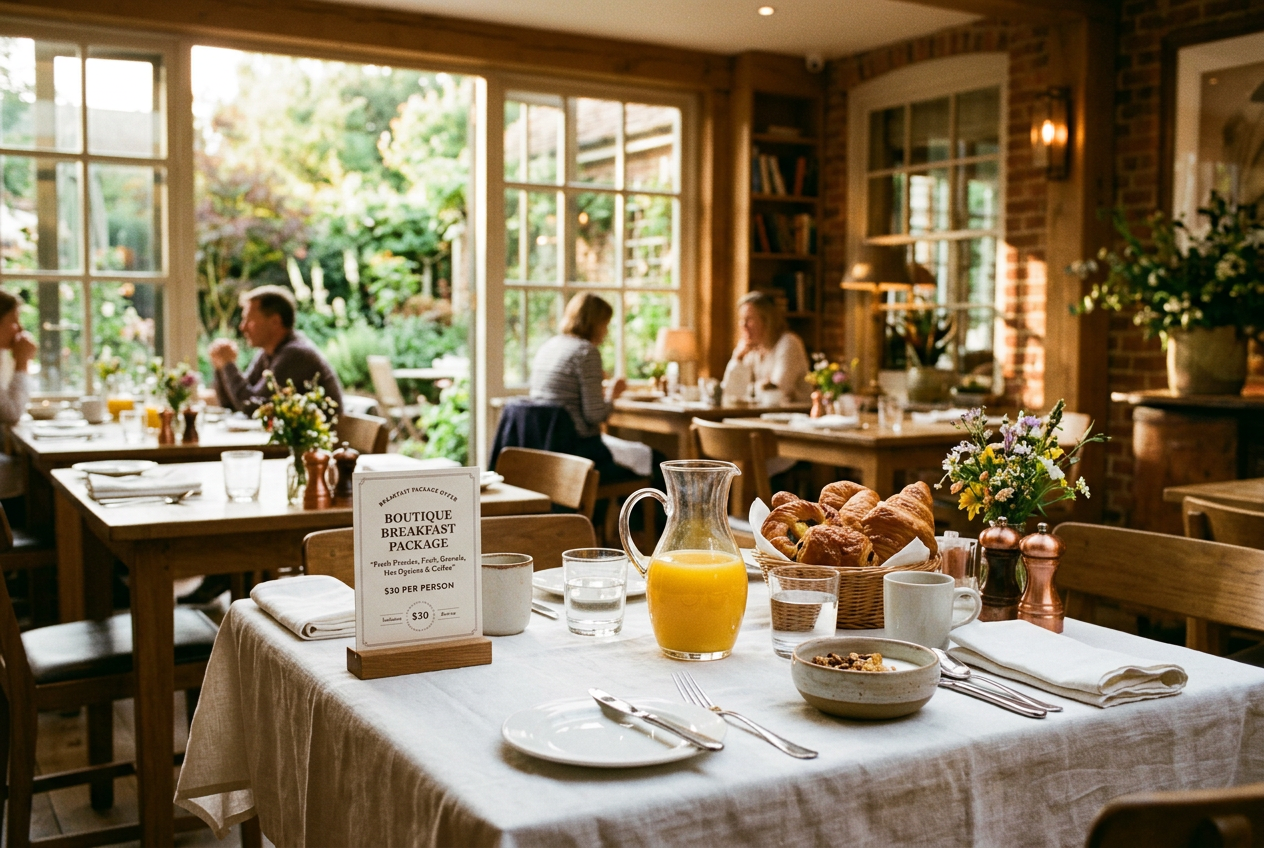
If your property offers breakfast, sell it as a pre-arrival package at a price point slightly below the walk-in rate. A breakfast that costs $18 at the door can be offered as a pre-arrival package at $15, creating perceived value for the guest while locking in revenue for the hotel.
The key is the pre-arrival timing. A guest who books a breakfast package two days before arrival has made a commitment. They show up for breakfast, which increases food and beverage utilization. A guest who decides on breakfast the morning of is making a spontaneous decision that may or may not happen.
Properties with breakfast package upsells built into their pre-arrival communication report breakfast utilization rates 20 to 30% higher than properties that rely on day-of decisions.
Three: Local Experience Partnerships
Every boutique hotel sits in a neighborhood that guests want to explore. Restaurants, wine tastings, kayak rentals, cooking classes, guided walking tours, wellness studios. These are experiences guests are going to pay for anyway. The question is whether the hotel captures a referral fee or a package margin, or whether the guest finds these experiences through Google and the hotel sees none of that revenue.
The simplest version of this is a curated recommendation list with booking links sent in the pre-arrival or day-of-arrival message. The hotel negotiates a 10 to 20% referral fee with local partners, or bundles the experience into a package at a markup. Either way, the guest gets a trusted recommendation and the hotel earns revenue from demand it was already generating.
The more sophisticated version involves creating signature packages that combine the room with one or two local experiences. An 'Artisan Weekend' that includes a room, a pottery workshop, and dinner at a local farm-to-table restaurant. A 'Coastal Escape' that includes the room, a guided kayak tour, and a sunset cocktail. These packages command premium pricing because they are selling an experience, not just a room.
Four: Room Upgrade Prompts at Strategic Moments
Room upgrades are most effective when offered twice: once at booking confirmation and once in the 48-hour pre-arrival message. The confirmation offer catches the guest while they are still in purchase mode. The pre-arrival offer catches them while they are getting excited about the trip.
A $30 to $50 upgrade from a standard room to a room with a balcony, a better view, or more square footage is an easy yes for many guests, particularly those traveling for a special occasion. The margin on a room upgrade is nearly 100% because the upgraded room was already in inventory.
Five: In-Room Welcome Amenities
A welcome amenity program offers guests the option to add a curated in-room experience to their stay. A bottle of local wine for $35. An artisan chocolate and cheese board for $45. A bath product upgrade with locally made soaps and candles for $25. A celebration package with flowers and champagne for $75.
These amenities feel personal and thoughtful to the guest. They are also highly profitable for the hotel because the cost of goods is typically 30 to 40% of the selling price, and the operational effort is minimal once the offerings are designed and the supply chain is set up.
The most effective way to present welcome amenities is as an add-on option in the pre-arrival communication sequence. A simple menu of three to four options embedded in the 48-hour pre-arrival message allows the guest to self-select with no pressure from the front desk.
The System That Makes It Work
The common thread across all five revenue streams is timing. Every upsell works better when it is presented proactively through an automated communication sequence than when it is offered reactively by a front desk agent during a busy check-in.
A guest offered late checkout at 7am will say no. The same guest offered it two days before arrival at $35 will say yes more often than most owners expect. A guest who sees a breakfast package in a pre-arrival email will purchase it at twice the rate of a guest who sees a sign in the lobby on arrival morning.
The technology to deliver these offers, whether through SMS, email, or a guest engagement platform, is neither expensive nor complex. What it requires is a deliberate decision to build the sequence, select the offers, and set the timing. Once running, the system generates revenue on autopilot, for every guest, every stay.
The Revenue Is Already in the Building
The guests are already there. They are already willing to spend beyond the room rate. The research consistently shows that travelers in 2026, particularly those choosing boutique and luxury properties, are actively seeking experiences, personalization, and added value. According to Deloitte's 2026 Travel Outlook, premium and experiential offerings continue to drive traveler spending even as financial caution increases.
The question is not whether the demand exists. It is whether the hotel has a system to capture it. For most independent boutique properties, the answer today is no. And that gap, measured conservatively, represents $100,000 to $300,000 in annual revenue that is sitting on the table waiting to be collected.
The five revenue streams outlined here do not require a large investment, a new hire, or a property renovation. They require a communication system, a set of offers, and the discipline to present them consistently. The properties that build this system will capture revenue that their competitors are leaving behind. And in a moderate growth market where room rate increases are slowing, ancillary revenue is the difference between a hotel that is growing and one that is standing still.
Want to Know What Ancillary Revenue Looks Like at Your Property?
BNHG builds custom revenue projections for independent boutique hotels that show exactly how much ancillary revenue your property can capture with a structured upsell system. A 15-minute discovery call is enough to run the initial numbers for your specific property size, ADR, and occupancy.
Book a free discovery call at https://www.benicehospitality.com